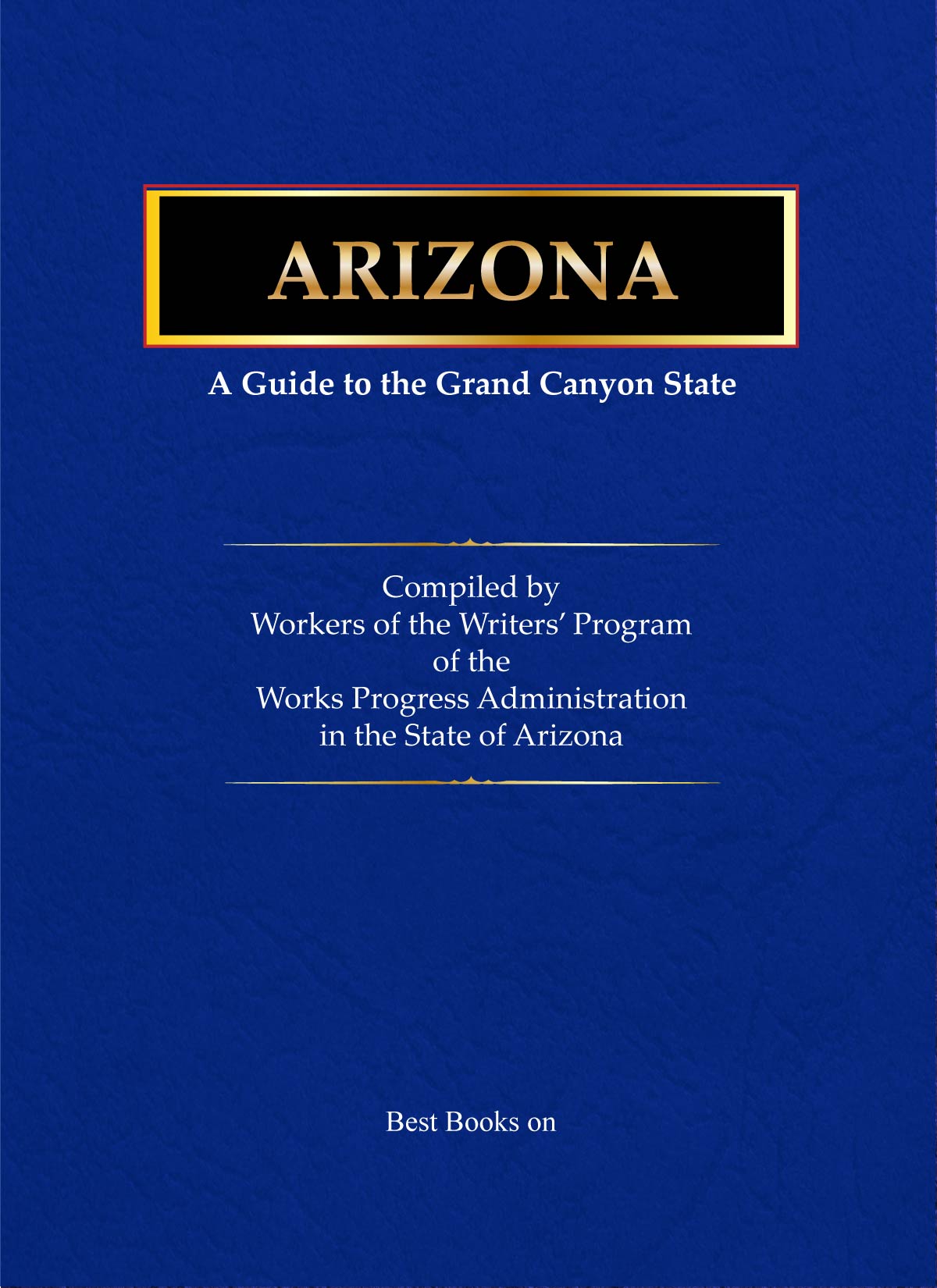
Introduction
A Study in Contrasts
Few states pack as many contradictions into their borders as Arizona, and the Writers’ Program guide leans into all of them. As the book’s foreword puts it, this is a place of wide-open spaces and color that nature has splashed generously — air-cooled-by-nature pine country in the north set against the air-cooled-by-man desert of the central valleys, the dude ranch beside the cattle ranch, the modern city beside the ancient Indian village, the public university beside the trading post. Arizona, the editors concluded, is a study in contrasts, and the guide is your guide so that you may know it.
The volume opens with Arizona’s background: the contemporary scene, the natural setting, the Indians and the archaeology that reach back long before the coming of the white man, and a history that runs through Spanish missions, territorial mining booms, and statehood in 1912. Essays follow on the “sunburnt West of yesterday,” agriculture, industry, transportation, education, the arts, architecture, and the distinctive Indian arts and crafts that set Arizona apart in the series. Part II profiles the cities — Bisbee, Douglas, Flagstaff, Globe, Phoenix, Prescott, Tombstone, Tucson, Yuma, and others — while Part III lays out the automobile tours that thread the state from the Utah line to the Mexican border.
This is the completely revised edition, prepared by Joseph Miller under the editorship of Henry G. Alsberg, who had directed the original Federal Writers’ Project nationally. Where the first guide closed in the early 1940s, this edition’s foreword to the revised edition carries the story forward: the airfields that sprang up across southern Arizona after Pearl Harbor, the aircraft and aluminum plants that pushed onto the desert, the new copper camp at San Manuel, the uranium found on the Navajo Reservation, and a cotton crop that crested at over a million bales in 1953. Arizona, the revisers noted, kept growing at a rapid pace into the post-war era.
What anchors the book, though, is the Grand Canyon itself, given its own section of park, rim, and trail tours — Bright Angel, Kaibab, Hermit, the routes down to the Colorado River and out to the remote North Rim. Together with the side trips to Canyon de Chelly, Monument Valley, and Rainbow Bridge, these pages preserve a mid-century portrait of a state whose scenery the guide rightly calls unsurpassed, written for the visitor and the lifelong Arizonan alike.
Contents
Table of Contents
Library Record
Full Bibliographic Record
- Title
- Arizona: The Grand Canyon State — A State Guide
- Author
- Compiled by Workers of the Writers’ Program of the Work Projects Administration in the State of Arizona
- Revised By
- Joseph Miller (completely revised); edited by Henry G. Alsberg
- Series
- American Guide Series
- Sponsor
- The Arizona State College at Flagstaff
- Foreword
- Thomas J. Tormey, former President, Arizona State College at Flagstaff
- Publisher
- Hastings House, New York
- Publication Date
- First published 1940; completely revised edition 1956
- Description
- Revised edition: approx. 532 p., illustrations, maps (tour maps on lining papers); 21 cm. Includes chronology, bibliography (p. 503), and index.
- Subjects
- Automobile travel — Arizona — Guidebooks; Arizona — Description and travel; Arizona — History; Arizona — Guidebooks
View this title’s catalog record on WorldCat.org.