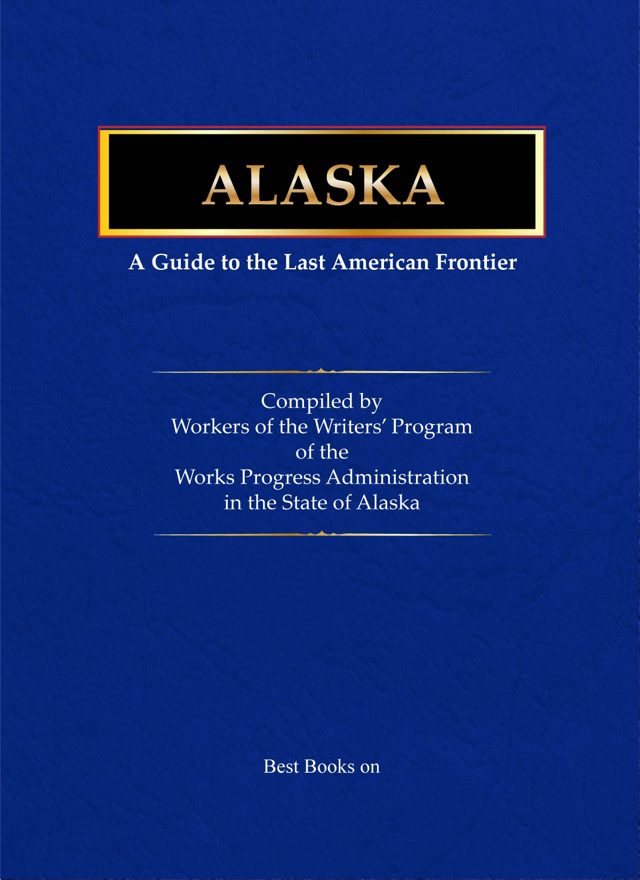
The Return of the Seasons
The best way to know Alaska, the Federal Writers’ Project conceded in its 1939 preface, is to spend a lifetime there; the next best is to watch the seasons turn. Merle Colby built the guide around exactly that idea. Following the old Tlingit calendar, his Alaska year opens in late August, when birds drift down from the mountains and the caribou on Eagle Summit catch the first flakes of snow even as Fairbanks suffers its summer heat. The months that follow carry their own names — the Snow Moon of November, the Goose Moon of January when the sun starts its long return, the Salmon Moon of June, and the thirteenth month, the Fattening Moon, when whites and Natives alike reckon up the year’s silver dollars.
That seasonal frame was the writers’ quiet argument against the schoolroom picture of Alaska as nothing but ice and snow. The Territory they describe is a working place of gold dredges and fishing fleets, of Matanuska farms whose giant squash and potatoes turn up at district fairs, of bush planes that land anywhere and a farthest-north university at Fairbanks. Governor Troy, in his foreword, dated the modern fascination to 1897, when word reached Seattle that the steamer Portland had arrived with “a ton of gold.” Klondike, Chilkoot Pass, and Nome Beach passed into the nation’s folklore — but the guide insists the less-told Alaska of its own day, the “foremost frontier” of aviation and modern mining, was no less dramatic.
Colby borrowed John Muir’s wry line that “great is the power of the guidebook maker, however ignorant,” and chose the discursive path: a book that not only marks the points of interest along each well-traveled route but pauses for the history, heritage, and humor that are Alaska’s own. The volume opens with practical matters — Preliminary Information, a bracing chapter on Popular Errors, an orientation to The Six Alaskas, and tours for “round-trippers.” Part I, The Great Land, sketches the Territory’s history, peoples, government, and natural wealth; Part II, The Last Frontier, runs the great travel routes from the Inside Passage and the Yukon Trail to the Steese Highway, Bristol Bay, the Seward Peninsula, and at last the Arctic shore at Barrow.
The writers were candid about the catch. Alaska, Colby wrote, may be the most rapidly changing section of the country, and no guidebook can keep pace: a small camp this year may be a roaring boom town the next, or already a ghost village. One postmaster, asked to verify the local facts, replied that his place was nothing but a cannery where a tourist would have a hard time getting a cup of coffee. Eight printings between 1939 and this 1944 Macmillan edition suggest readers forgave the guide its loose ends and traveled north anyway.
Table of Contents
Transcribed from the 1944 editionPart I · The Great Land
Part II · The Last Frontier
Reference
Bibliographic Record
- Title
- A Guide to Alaska: Last American Frontier
- Author / Compiler
- Merle Colby, for the Federal Writers’ Project of the Works Progress Administration
- Series
- American Guide Series
- Sponsor
- John W. Troy, Governor of Alaska
- Foreword
- John W. Troy, Governor of Alaska
- Preface
- Merle Colby
- Publisher
- The Macmillan Company, New York
- Dates & Printings
- Copyright 1939 by John W. Troy. First published July 1939; reprinted June 1940, August 1941, February 1942, September 1942, January 1943, April 1943, September 1943, and July 1944 (the printing reproduced here).
- Printer
- J. J. Little and Ives Company, New York
- Physical Description
- xcix, 427 pp. · illustrated, with maps and pictorial endpapers · index
- Subjects
- Alaska — Description and travel; Alaska — Guidebooks; Federal Writers’ Project