Introduction
Where Time Becomes Visible
New Mexico today, the foreword announces, “represents a blend of three cultures: Indian, Spanish, and Anglo-American,” and the New Mexico Writers’ Project spends the next four hundred pages proving it. In the pueblo the old religious ceremonies still go forward; in the nearby village the descendants of Spanish and Mexican settlers move to folk songs carried long ago from Spain and Mexico; and over both drifts the roar of air transport and the sweep of the transcontinental streamliner. Four centuries are pressed into a single living moment.
The book dates that moment to 1540, the year Vásquez de Coronado entered the “northern borderlands” chasing fabled treasure and brought with him the first cattle, sheep, and swine to reach what would become great range country. Coronado founded no lasting settlement, the foreword notes, yet his followers now visit a land of enchantment — the ancient cities of Santa Fe, Taos, and Ácoma, fabled as a sky city before he ever came; the historic shrines of Inscription Rock and Old Mesilla; the scenic wonders of Carlsbad Caverns and the White Sands. As its author, Clinton P. Anderson, puts it, “Here in New Mexico, time becomes visible.”
The Writers’ Program does not pretend to have exhausted the subject. The preface admits, with disarming candor, that “several volumes would be required for an adequate likeness,” and that what is missing is not in material but in space to present it. Where the wordage runs heavy toward history and the Indians, the editors offer no apology: the most vigorous Indian tribes in the country are here, and no state is richer in historical incident. Captains of industry, they add wryly, are at best second lieutenants in New Mexico — “the land’s the thing!”
That conviction shapes the architecture of the guide. Part I, “Before and After Coronado,” moves from the land and its archeology through the Indians and four hundred years of history into agriculture and stock raising, industry, transportation, folklore, religion, education, literature, music, architecture, and New Mexican art. Part II turns to “A City, a Capital, and an Art Center” — Albuquerque, Santa Fe, and Taos. Part III, “The Most Accessible Places,” lays out eighteen numbered automobile tours and their lettered branches, threading the state from the Colorado line to El Paso and from the Texas plains to the Arizona desert, by way of Ácoma, Chaco Canyon, Shiprock, and Carlsbad Caverns. A chronology, a reading list, and an index close the volume.
For all its historic age, the writers conclude, New Mexico remains in many respects a frontier, its three cultures still guarding jealously their own traditions. That this guide tempts the reader to look is precisely its point.
Contents
Table of Contents
Library Record
Full Bibliographic Record
- Title
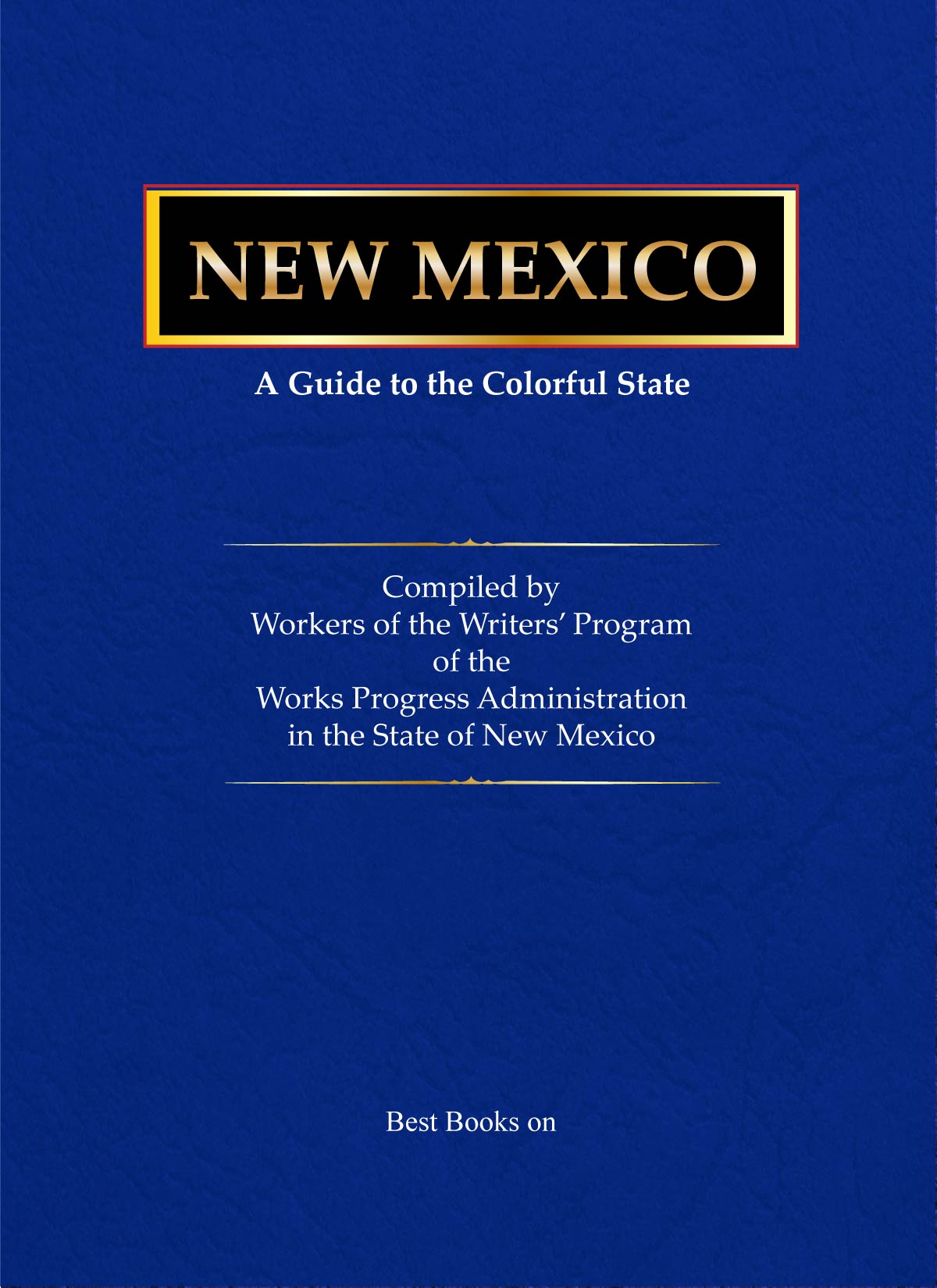
- New Mexico: A Guide to the Colorful State
- Author
- Compiled by Workers of the Writers’ Program of the Work Projects Administration in the State of New Mexico (New Mexico Writers’ Project)
- Series
- American Guide Series
- Sponsor
- Coronado Cuarto Centennial Commission (state-wide sponsor) and the University of New Mexico
- Foreword
- Clinton P. Anderson, Managing Director, United States Coronado Exposition Commission
- Publisher
- Hastings House, New York
- Publication Date
- First published August 1940 (copyright 1940 by the Coronado Cuarto Centennial Commission)
- Description
- Illustrated: plates, maps (key map of New Mexico tours); roman-numeral front matter through xxvii, main text paginated to 441 (index). Includes a chronology, a reading list (“Some Books about New Mexico”), and an index.
- Subjects
- Automobile travel — New Mexico — Guidebooks; New Mexico — Description and travel; New Mexico — History; New Mexico — Guidebooks
View this title’s catalog record on WorldCat.org.