Introduction
From the Delta to the Piney Hills
By the time the Federal Writers’ Project turned to a full guide for Louisiana, the state’s unit had already proven itself: the volume was, as its sponsors noted in a foreword dated September 1940, the second major accomplishment of the Louisiana Writers’ Project, following the well-received New Orleans City Guide of two years earlier. The aim this time was larger and harder — to present as complete a picture of Louisiana as a single volume could hold without becoming, in the project’s own phrase, too unwieldy. The finished book, first published by Hastings House in 1941 and reprinted twice by 1945, runs past eight hundred pages and still leaves the sense of a state that resists being summarized.
The method was deliberately decentralized. Field offices in Alexandria, Gretna, Lafayette, Lake Charles, Monroe, New Orleans, and Shreveport gathered material across the state, which the New Orleans office then revised, supplemented, and re-checked on the ground. The guide was sponsored by the Louisiana Library Commission, whose executive secretary Essae M. Culver signed the foreword alongside Paul M. Hebert, acting president of Louisiana State University, the project’s state-wide sponsor. Specialists from the archives, the universities, and the New Orleans press read and corrected the manuscript, and the long tour section was checked mile by mile in the field.
Part I, “Louisiana: Past and Present,” ranges from the natural setting and the state’s first peoples through history, government, and industry into the cultural chapters that give the volume its character — racial elements, folkways, religion, literature, music, the theater, and a chapter on cuisine that few other state guides could match. Part II portrays sixteen cities and towns, from New Orleans and Baton Rouge to Natchitoches and the old Acadian center of St. Martinville. Part III, the heart of the book, lays out nineteen numbered motor tours and their many lettered branches, threading the delta, the bayou country, the prairies, and the northern piney hills, with side routes by boat to Grand Isle, the Chitimacha reservation, and the marsh settlements below New Orleans.
A closing set of appendices adds a glossary of the French, Creole, and Acadian terms a traveler would meet, a chronology, a bibliography, population figures from the 1940 census, and an index. Read today, the Louisiana volume is both a working period guidebook and a portrait of the state on the edge of the Second World War — a place where French, Spanish, African, Acadian, and Anglo-American currents had mingled for two centuries, and where, as the guide everywhere suggests, the map is never quite the whole story.
Contents
Table of Contents
Library Record
Full Bibliographic Record
- Title
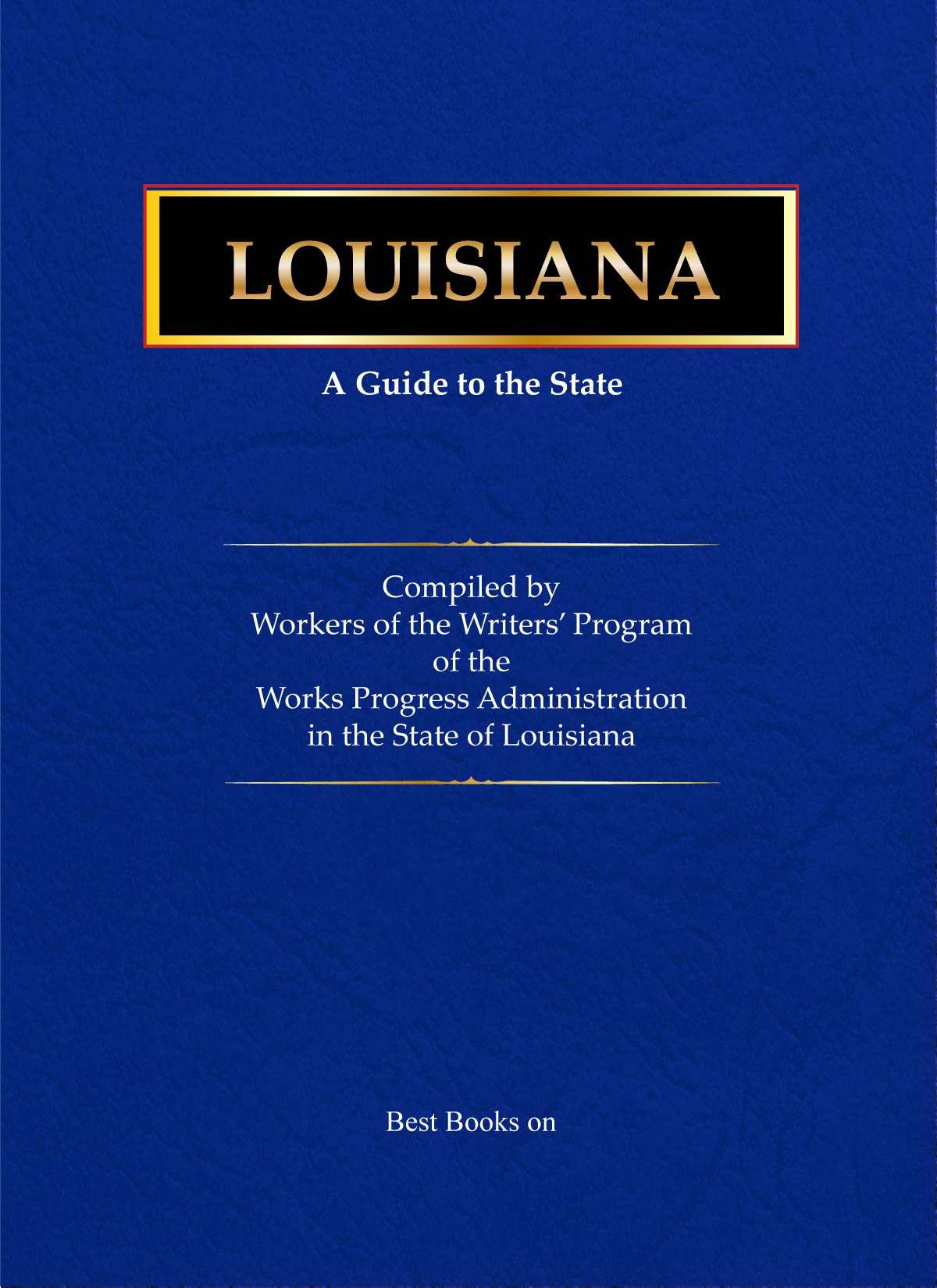
- Louisiana: A Guide to the State
- Author
- Federal Writers’ Project — Workers of the Writers’ Program of the Work Projects Administration in the State of Louisiana
- Series
- American Guide Series (Illustrated)
- Sponsor
- Louisiana Library Commission at Baton Rouge; state-wide sponsor, Louisiana State University (Louisiana Writers’ Project)
- Foreword
- Essae M. Culver, Executive Secretary, Louisiana Library Commission; and Paul M. Hebert, Acting President, Louisiana State University (September 30, 1940)
- Publisher
- Hastings House, New York
- Publication Date
- First published 1941 (second printing 1943; third printing 1945); copyright 1941 by the Louisiana Library Commission
- Printing
- Printed in the United States of America
- Description
- Front matter (i–xxx) and text to the index (beginning p. 735); illustrated with photographs and maps. Includes a Glossary (p. 685), Chronology (p. 693), Bibliography (p. 704), Population Figures from the 1940 Census (p. 717), and an Index.
- Subjects
- Louisiana — Description and travel — Guidebooks; Louisiana — History; Automobile travel — Louisiana — Guidebooks
Search for this title’s full catalog record on WorldCat.org.