Introduction
A Portrait Stitched from Three Hundred Years
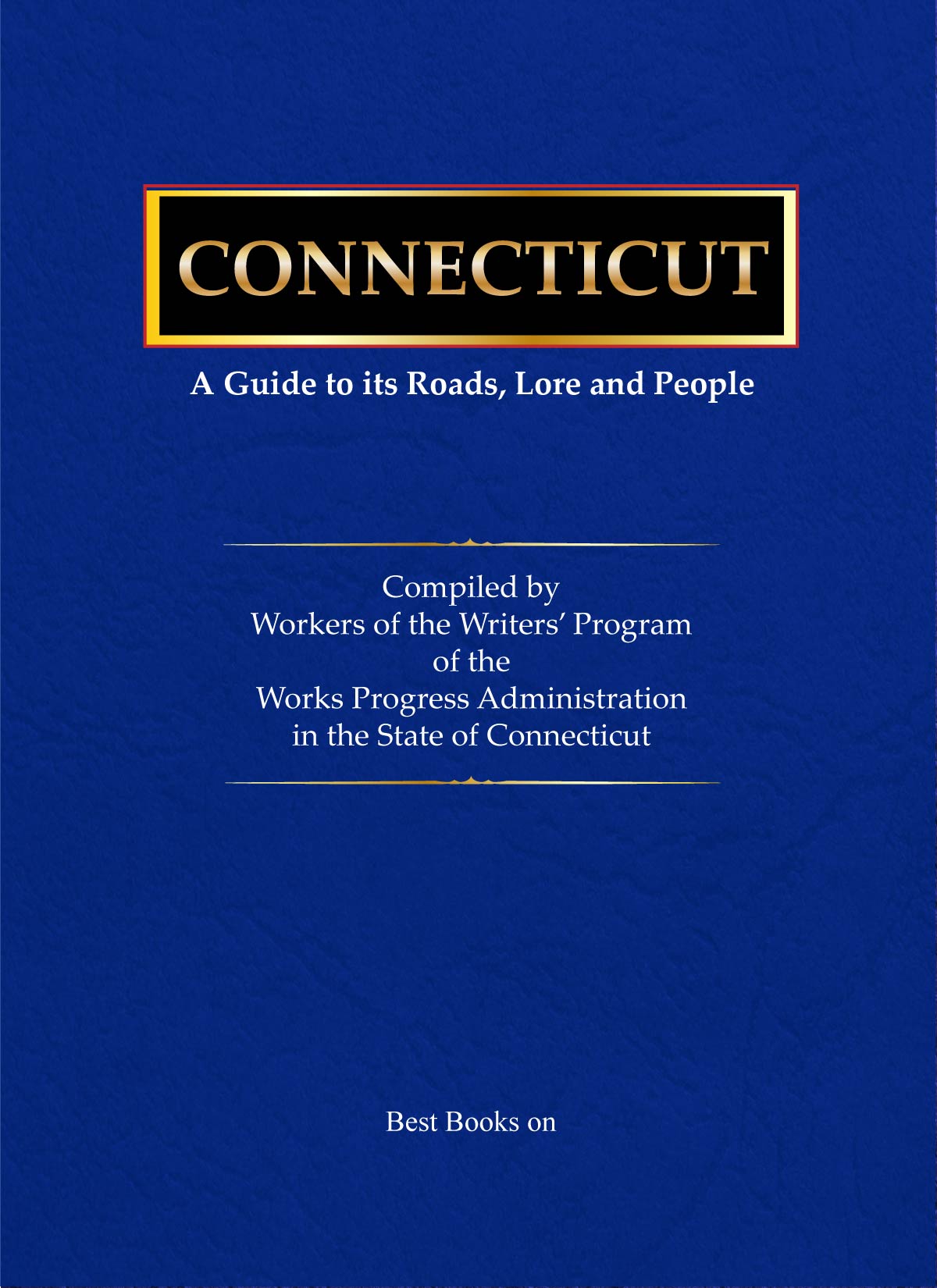
Connecticut was the seventh state to receive a volume in the American Guide Series, published in 1938 by Houghton Mifflin Company under an unusual arrangement: Governor Wilbur L. Cross not only sponsored the book but wrote its foreword in his own hand, calling it “a most valuable contribution to Connecticut history.” The body of the guide was compiled by workers of the Federal Writers’ Project under State Director John B. Derby, whose preface confesses the central difficulty of the undertaking: present-day Connecticut, he wrote, was “too diversified and restless to yield an easy likeness,” and a guidebook could at best offer thumbnail sketches and leave the visitor to assemble the rest.
Derby framed the Project’s work as a continuation of an older tradition. A century earlier, John Warner Barber had driven from town to town by horse and buggy compiling his 1836 “Historical Collections,” sketching all 136 of the state’s towns as they stood at the close of an eighteenth-century pattern of life, just before industry began to reshape them. The Federal Writers saw their own task as Barber’s counterpart for the machine age, and they acknowledged a more immediate debt as well, to Edgar L. Heermance, whose earlier “Connecticut Guide” he generously allowed them to draw upon.
Much of the preface’s historical essay dwells on a paradox: for roughly sixty years, from 1780 to 1840, Connecticut’s population remained nearly static while its neighbors in New England grew several times over, even as the state was quietly becoming a forge of American invention. Eli Whitney of New Haven and Simeon North of Berlin pioneered interchangeable parts in firearms manufacture during these same decades, Yankee peddlers carried tinware and wooden notions as far as Detroit and New Orleans, and Connecticut inventors led the nation in patents per capita almost from the moment the Patent Office opened in 1790. The same years produced the Hartford Wits, Noah Webster, and Yale President Timothy Dwight, a conservative literary establishment functioning alongside, and sometimes in tension with, the restless industry growing up around it.
The guide proper unfolds in three parts. The first lays out Connecticut’s natural setting, Indian history, government, industry, and arts in seventeen essays running from general description to a closing list of “Connecticut Firsts.” The second, “Main Street and Village Green,” profiles twenty-three cities and towns from Bridgeport to Windsor, anchored by an extensive tour of Hartford and New Haven. The third and longest section, “High Roads and Low Roads,” lays out ten numbered automobile tours and dozens of lettered side trips, a mile-by-mile road book threading every corner of the state from the New York line to the Rhode Island line.
Read today, the Connecticut guide stands as both a practical period road book and a self-portrait the state commissioned of itself during the Depression, written under a governor willing to put his own name to its foreword and a State Director candid enough to admit that no single book could fully capture so restless a place.
Contents
Table of Contents
Library Record
Full Bibliographic Record
- Title
- Connecticut: A Guide to Its Roads, Lore, and People
- Author
- Written by Workers of the Federal Writers’ Project of the Works Progress Administration for the State of Connecticut
- Series
- American Guide Series
- Sponsor
- Wilbur L. Cross, Governor of Connecticut
- Foreword
- Harry L. Hopkins, Federal Administrator, WPA; and Wilbur L. Cross, Governor of Connecticut
- Preface
- John B. Derby, State Director, Federal Writers’ Project
- Publisher
- Houghton Mifflin Company, Boston (The Riverside Press, Cambridge)
- Publication Date
- 1938
- Description
- xxxi, 593 p.: illustrations, maps; 21 cm. Includes Chronology, Selected Reading List (p. 562–566), General Index, and Index of Old and Historic Houses.
- Subjects
- Automobile travel — Connecticut — Guidebooks; Connecticut — Description and travel; Connecticut — History; Connecticut — Guidebooks
View this title’s catalog record on WorldCat.org.